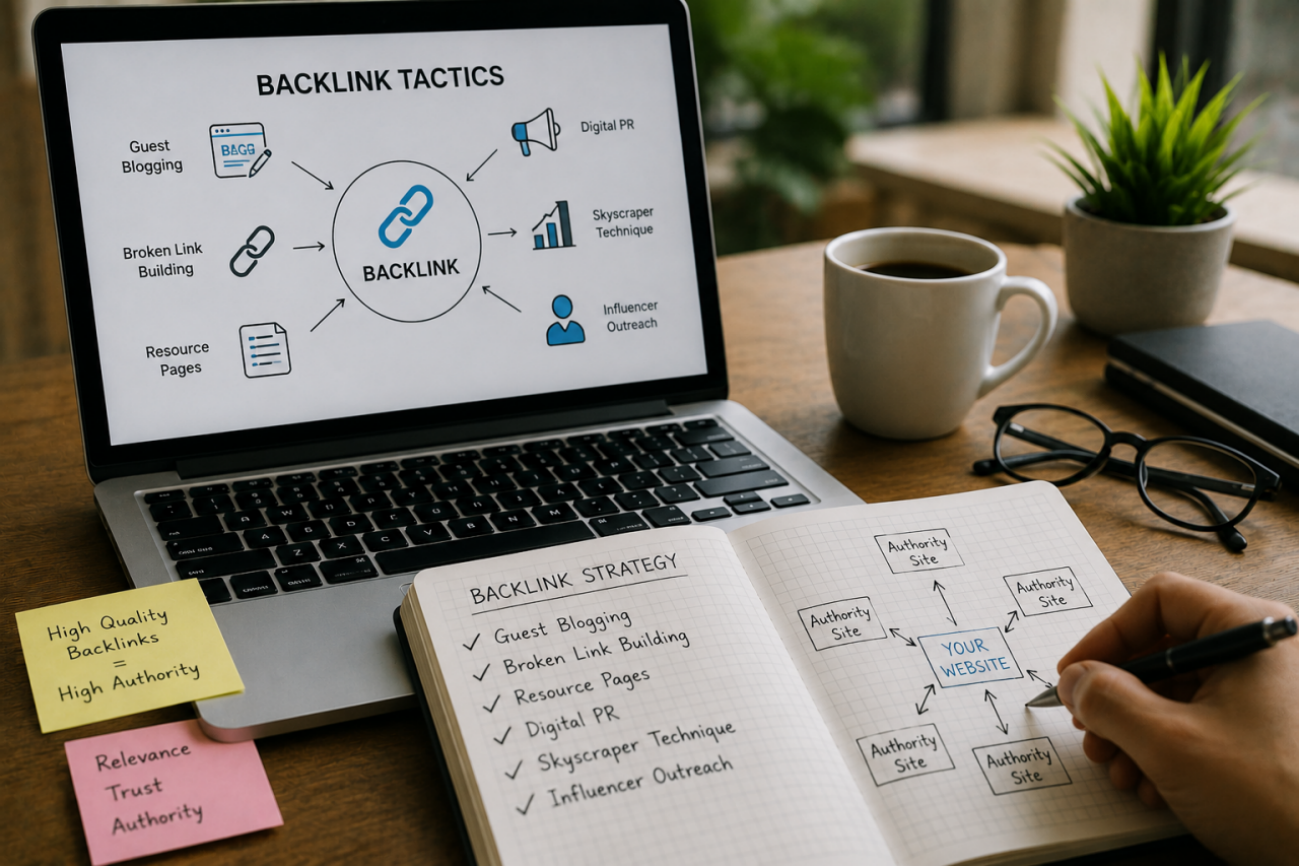
Backlinks remain one of the strongest trust signals inside Google’s ranking system, and for UAE businesses competing across a crowded Dubai market, they often decide who gets found first and who gets overlooked. At Searchical SEO, we build authority the right way, through relationships, data and genuine value rather than shortcuts or bulk-bought links. This guide walks through seven proven backlink tactics that help your website earn the recognition it deserves.
Key Takeaways
- Quality backlinks from relevant, high-authority sites matter more than sheer quantity.
- Digital PR and guest contributions build trust with readers and search engines alike.
- Original data and research content naturally attract citations from other sites.
- Local business associations and directories offer genuine, UAE-specific link opportunities.
- Consistent, patient outreach compounds into stronger rankings over time.
Backlinks have been part of search engine algorithms since the earliest days of Google, and despite years of change, they still carry real weight. A link from a respected source tells search engines that other people trust your content enough to point their own audience toward it. For businesses across Dubai, Abu Dhabi and the wider Emirates, that trust signal can mean the difference between sitting on page two and dominating page one of the results. It is worth remembering that not every link carries equal value. A single mention from a site your customers actually read and respect will usually outperform a hundred links scattered across low-quality, unrelated pages, which is why the tactics below focus on relevance first and volume second. Below are seven tactics our team relies on to help clients build backlink profiles that actually last, rather than ones that fade or trigger penalties a few months later.
1. Earn Coverage Through Digital PR
Digital PR is one of the most effective ways to secure links from publications that genuinely matter to your audience. Rather than chasing volume, the goal is to pitch a story, an announcement or a useful data point that a journalist actually wants to cover. Regional business titles such as Khaleej Times and Gulf News regularly feature commentary from UAE business leaders, and a mention in either carries real authority with both readers and search engines.
Getting a pitch accepted takes more than a generic press release. Editors receive dozens of submissions a week, so the ones that stand out are specific, timely and easy to act on immediately. It also helps to have a small library of company facts, founder bios and high-resolution images ready in advance, since a journalist working to a tight deadline will often move on if they cannot find what they need within a few minutes.
To make digital PR work for your brand:
- Pitch timely, newsworthy angles rather than promotional press releases.
- Address journalists by name and reference their recent coverage.
- Offer data, quotes or original research they can use straight away.
- Follow up once, politely, rather than repeatedly chasing a response.
A single feature in a trusted regional outlet often does more for your domain’s credibility than dozens of low-quality directory links combined, and the relationship can lead to further coverage down the line. It also pays to think beyond a single placement. Once a journalist covers your business once, they are far more likely to consider you a reliable source the next time a relevant story comes up, which turns a single successful pitch into a recurring source of coverage rather than a one-time win.
2. Contribute Guest Content to Respected Publications
Guest posting still works when it is done with care and restraint. The trick is choosing publications your customers actually read, then offering them something genuinely useful rather than a thinly disguised advertisement for your services. Business platforms such as Zawya accept well-researched commentary from credible contributors, and appearing alongside established regional voices lends your brand instant context and credibility.
Before pitching a guest piece, it helps to slow down and do some groundwork first, since a rushed pitch is usually an easy one to reject. Consider the following before you reach out:
- Research the publication’s tone and previous articles first.
- Propose an angle that has not already been covered elsewhere.
- Include one relevant, non-promotional link back to your site.
- Keep the pitch short, since editors are busy and appreciate clarity.
If you already run a content calendar, this tactic is a natural extension of it. It also helps to think of guest content as a long-term investment rather than a single transaction. A handful of well-placed pieces published over a year will usually do more for your authority than a rushed batch of ten submitted in a single month.
3. Publish Original Data and Research
Nothing attracts backlinks quite like original data. When you publish a study, survey or market snapshot that other writers can cite, you effectively create a magnet for future links, since journalists and bloggers are always searching for a fresh statistic to support their own articles. According to the UAE government’s own overview of the digital economy, the country’s technology adoption rate is among the highest in the world, which means local audiences respond particularly well to data-backed content.
Academic research reinforces this pattern too. A widely cited paper published on the role of backlinks in search engine ranking found that sites earning genuine external citations consistently outperform those relying on volume alone. Separately, a peer-reviewed study on digital marketing’s impact on SME growth found a clear link between structured, data-informed strategies and measurable business outcomes, a conclusion echoed by researchers within the marketing faculty at the American University of Sharjah.
Turning this into a repeatable habit is easier than it sounds:
- Survey your own customers or industry contacts for fresh insight.
- Turn internal performance data into a shareable, anonymized report.
- Present findings visually so journalists and bloggers can use them easily.
- Update the data annually to keep the piece relevant and linkable.
Even a modest survey of thirty or forty customers can produce a statistic worth sharing, so this tactic is well within reach for smaller businesses too, not just large enterprises with dedicated research teams.
4. Get Listed With Local Business Associations and Directories
The UAE has a dense network of business councils, chambers and free-zone directories that most companies never think to approach, despite how straightforward membership usually is. Joining a group such as the American Chamber of Commerce Dubai often includes a listing on their member directory, which provides a genuinely relevant, locally rooted link rather than a generic international one. Trade publications like Gulf Business also maintain directories and feature sections that are worth exploring for the right industry.
These listings rarely bring a flood of traffic on their own, but they signal something search engines value highly: that your business is a real, verifiable participant in the local economy.
Worth pursuing over the coming months:
- Chamber of commerce memberships relevant to your industry.
- Free-zone authority directories if your company is registered there.
- Industry-specific associations tied to your sector.
- Alumni or professional networks with an online member listing.
These links tend to be modest in number but strong in relevance, which is exactly what modern search algorithms reward over sheer volume. Many chambers also publish member spotlights or newsletters, which can turn a simple membership into an additional piece of earned coverage without any extra outreach on your part.
5. Reclaim Broken Link Opportunities
Every website accumulates broken links over time, whether from outdated pages, closed businesses or sites that have been restructured without proper redirects. Finding these gaps and offering your own content as a suitable replacement is one of the more underused backlink tactics available today. It takes patience, but the success rate tends to be higher than cold outreach because you are solving a genuine problem for the site owner rather than asking for a favor.
Running this tactic well involves a few consistent steps:
- Identify relevant pages in your industry with outdated or dead links.
- Check that your own content genuinely fits as a replacement.
- Reach out with a short, specific message naming the broken link.
- Track responses and follow up once after a reasonable interval.
A tidy, well-structured website matters here too, since a confusing or outdated site can undo the goodwill you build through outreach. If your own site’s architecture is holding these efforts back, web design team at Searchical SEO can help rebuild a foundation that is easier for both users and search engines to navigate. This tactic also doubles as a useful audit of your own site, since checking other websites for broken links often reveals gaps and outdated pages within your own content library too.
6. Showcase Case Studies and Client Results
Publishing detailed case studies does double duty. It gives potential clients proof of results, and it gives other sites, particularly partners, suppliers and industry press, a genuine reason to link back to you. A well-documented success story, complete with real figures and a clear before-and-after narrative, is far more link-worthy than a generic testimonial page that simply repeats a few kind words.
Case studies also age well. Unlike a seasonal promotion, a strong result-driven story can keep earning links and referral traffic for years after it was first published.
To build case studies that attract links naturally:
- Include specific, verifiable numbers wherever possible.
- Name the client where permission allows, or describe the industry clearly.
- Explain the strategy in enough detail that readers actually learn something.
- Share the finished piece directly with the client for their own promotion.
Clients are often happy to link back to a case study that reflects well on their own business, which creates a natural, mutually beneficial arrangement that requires no further outreach. Over time, a growing library of case studies also becomes a resource in its own right, one that prospective clients browse before they ever pick up the phone or send an inquiry.
7. Build Genuine Industry Relationships
Ultimately, most durable backlinks come from real relationships rather than one-off requests sent to strangers. Commenting thoughtfully on industry discussions, collaborating with complementary businesses and staying visible at trade events all lay the groundwork for links that arrive without you ever having to ask for them directly. Coverage in outlets such as Arabian Business is rarely won through a single email; it usually follows months of consistent, credible presence within the wider conversation.
This is the slowest tactic on the list, but also the one that compounds the most reliably over a long period of steady effort. It also tends to protect your brand during quieter periods, since businesses with an established network of genuine relationships rarely struggle to find a willing collaborator, contributor or reference when a new opportunity comes along.
Ways to nurture these relationships over time:
- Engage genuinely with industry peers on professional social platforms.
- Offer expert commentary whenever journalists request sources for a story.
- Collaborate on joint content, webinars or research with complementary brands.
- Stay patient, since the strongest backlink profiles are built over months, not days.
None of these steps requires a large budget. What they do require is consistency, a genuine point of view, and a willingness to show up in the same spaces as your customers and peers, again and again, until your brand becomes a familiar and trusted name.
Conclusion
Backlinks are not a box to tick once and forget about. They are the product of steady, credible work that search engines recognize and reward over time, and the tactics above are the same ones we use with our own clients across the UAE. If you would like a team that treats your backlink strategy with the same care as everything else on your website, get in touch with us and we will help you build the authority your business deserves.
FAQs:
How many backlinks does a website need to rank well?
There is no fixed number of backlinks required to rank well. The relevance, quality, and authority of the linking websites are far more important than the total number of links.
Are paid backlinks safe for SEO?
Paid backlinks that violate search engine guidelines can result in penalties and ranking losses. Editorially earned backlinks from reputable websites remain the safer and more sustainable approach.
How long does it take to see results from link building?
Most businesses begin to see ranking improvements from consistent link building within six to twelve months, although results vary depending on competition, website authority, and the quality of backlinks earned.
Can guest posting still help SEO in 2026?
Yes. Guest posting can still improve SEO in 2026 when it provides valuable, original content published on relevant and reputable websites rather than low-quality or spam-focused blogs.
What is the difference between a backlink and a citation?
A backlink is a clickable hyperlink that points to your website, while a citation is simply a mention of your business or brand name without necessarily including a direct link.
Should small businesses invest in digital PR?
Yes. Digital PR can help small businesses earn coverage from reputable publications, increasing brand credibility, improving online visibility, and creating opportunities to earn high-quality backlinks.
