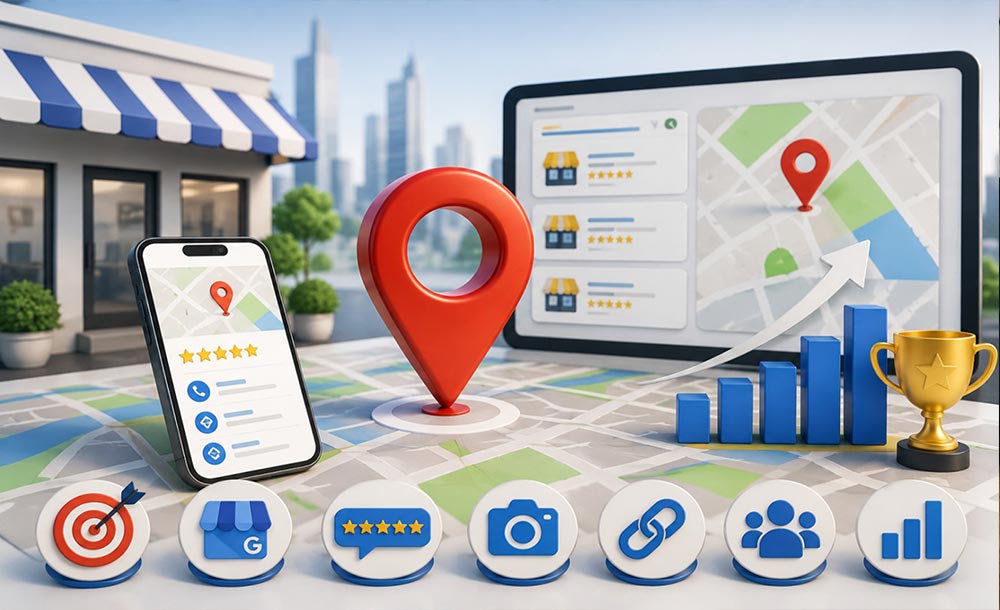
Ranking on Google Maps can make or break a local business in the UAE, and at Searchical SEO, we see this play out every single week. When your business appears in that coveted three pack, calls, direction requests and walk ins tend to follow close behind. This guide walks through seven practical, proven tricks that help Dubai and UAE businesses climb to the top of Google Maps and stay there.
Key Takeaways
- Complete every field on your Google Business Profile, not only the basics.
- Collect reviews steadily, month after month, rather than in bursts.
- Keep your business name, address and phone number identical everywhere online.
- Refresh your profile with new photos and posts on a regular basis.
- Build genuine local citations and community backlinks over time.
The UAE is one of the most connected markets on earth, with internet use among residents sitting close to the entire population, so the businesses that show up first on Google Maps capture an outsized share of local demand. From a customer standing outside a mall in Dubai Marina to someone searching for a dentist in Abu Dhabi, that three pack at the top of the map is often the only shortlist people ever see. Miss it, and even the best product or service can struggle to get noticed. This is why so many owners across the Emirates, from restaurant groups to clinics to real estate firms, now treat Google Maps visibility as a core part of running the business rather than a side project.
What makes Google Maps different from ordinary website SEO is that it blends online signals with real world proximity. A searcher’s location, the categories you choose, the words inside your reviews and the consistency of your listing all feed into a single decision about which three businesses appear first. None of the seven tricks below are secret hacks. They are the fundamentals done properly and kept up over time, which is exactly why so few competitors bother to do all of them well.
1. Claim and Fully Verify Your Google Business Profile
Your Google Business Profile is the foundation everything else is built on. It is free to set up, yet many owners leave it half finished, missing services, attributes or even a proper description. Google’s own guidance on local ranking confirms that complete, accurate listings are far more likely to appear in local results, and Google is fairly explicit that thin or unverified profiles get pushed down the list before anything else is even considered.
Verification matters just as much as completeness. An unverified listing can still appear on Google Maps, but it carries far less weight, and it is also far easier for a competitor or a malicious edit to hijack your details. Once verified, treat the profile as a living page rather than a form you fill in once and forget.
- Fill in every section, including hours, services, attributes and a clear business description.
- Choose a physical address that matches your storefront exactly, down to the suite number.
- Verify your listing using whichever method Google offers for your business type.
- Set special hours ahead of UAE public holidays so customers are never misled.
2. Get Your NAP Consistency Right
NAP simply means your Name, Address and Phone number. Google cross checks this information across the web, and mismatches quietly chip away at trust. A listing that reads slightly differently on your website, a directory and social media sends mixed signals, and enough of those small mismatches can convince Google that two listings actually belong to different businesses.
This becomes more complicated in the UAE than in many markets, since a single business can appear under an English name, an Arabic name, a free zone address and a mainland address all at once. Picking one consistent version of each detail and using it everywhere, from your website footer to your invoices, removes a surprising amount of friction from the ranking process.
- Audit your listings on directories, social platforms and industry sites at least twice a year.
- Use the exact same formatting for your phone number and suite details everywhere.
- Fix duplicate or abandoned listings before they compete with your main profile.
- Keep Arabic and English versions of your business name aligned across every platform.
3. Earn Reviews the Right Way
Reviews carry real weight in Google’s local algorithm, and they shape whether a customer picks up the phone in the first place. The trick is consistency, not volume in a single week. A steady trickle of two or three genuine reviews every week tends to help far more, over a year, than fifty reviews collected in a single push and then silence for months afterward.
The wording inside a review matters too. A customer who writes about the specific service they received, rather than a generic comment, gives Google extra context about what your business actually does well. You cannot script this, but you can gently prompt for it by asking a specific question when you request the review, such as how their visit or project went.
- Ask happy customers for a review right after the service is finished, while it is fresh.
- Reply to every review, good or bad, in a calm and professional tone.
- Avoid review gating or incentives; Google penalises listings that break its guidelines.
- Prompt customers with a specific question so their review naturally mentions your service.
4. Pick the Sharpest Categories
Your primary category tells Google exactly what you do, so vague choices cost visibility. Whether you run a dental clinic, a car dealership or an estate agency, the most specific accurate category almost always outperforms a broad one. Choosing a generic label such as Business Service instead of the exact match available makes it harder for Google to know which searches you should appear for, even if your website and reviews are excellent.
Secondary categories are worth adding, but only where they genuinely reflect part of your business. Piling on unrelated categories to try and appear for more searches usually backfires, since it dilutes the relevance signal Google relies on and can even look like an attempt to game the system.
- Select one primary category that matches your core service precisely.
- Add secondary categories only where they genuinely apply to what you offer.
- Revisit your categories whenever your services change or expand.
- Check how competitors in your area are categorised before finalising your own choice.
5. Post and Update Photos Regularly
An active profile signals to Google, and to customers, that a business is genuinely open and engaged. Fresh photos, short updates and seasonal posts all add small but steady ranking signals over time, and they also do a lot of quiet work convincing a browsing customer to choose you over a listing with only a handful of old, blurry photos.
Entrepreneur Middle East has noted that UAE businesses which lean into digital tools tend to pull ahead of slower moving competitors, and a Google Business Profile is one of the simplest tools available. Treat it the same way you would treat an Instagram page: worth ten minutes of attention every couple of weeks, not something you set up once and never touch again.
- Upload new, well lit photos of your storefront, team and products every month.
- Use Google Posts to share offers, events or short updates.
- Keep your business hours accurate, especially around UAE public holidays.
- Remove outdated photos that no longer reflect your current location or offering.
6. Build Local Citations and Backlinks
Citations, which are simply mentions of your business on other reputable sites, reinforce your prominence in Google’s eyes. Combined with backlinks from relevant local sources, they tell Google that your business is established and trusted rather than a listing that appeared overnight.
Research on digital adoption among UAE SMEs has pointed out that many smaller regional businesses still underinvest in structured digital marketing compared with larger corporations. That gap is an opportunity. A handful of genuine citations from chambers of commerce, trade associations or local news coverage can meaningfully outweigh a competitor who has never bothered to build any at all.
- List your business on reputable UAE directories and chambers of commerce.
- Seek mentions from local news sites, industry bodies and community pages.
- Avoid low quality directories that add little more than a stray link.
- Sponsor or take part in local events that naturally generate a mention and a link.
7. Strengthen Your Website’s Local SEO
Google Maps rankings increasingly lean on signals from your website itself. A fast, mobile friendly site with clear location pages supports everything above it.
This matters more in the UAE than almost anywhere else, since Statista’s research on the UAE digital market shows one of the highest internet penetration rates in the world, and the vast majority of that browsing happens on a phone. A slow website that struggles to load on mobile data quietly undoes much of the good work done on your Google Business Profile, since Google is watching how people behave after they click through.
- Add your city and area names naturally within page titles and headings.
- Embed a Google Map and full address on your contact page.
- Keep load times quick, since most UAE searches now happen on mobile.
- Create a dedicated page for each location if your business operates in more than one emirate.
Common Mistakes That Hold UAE Businesses Back
Even businesses that follow most of the advice above sometimes stall out because of a handful of avoidable mistakes. Recognising them early saves months of wasted effort.
- Setting an unrealistically wide service area, which spreads relevance too thin to rank anywhere well.
- Letting a profile sit untouched for months, then wondering why rankings have slipped.
- Copying a website’s homepage content across multiple location pages word for word.
- Ignoring negative reviews instead of responding calmly and offering to resolve the issue.
- Treating Google Maps as a one time project rather than an ongoing part of marketing.
Conclusion
Ranking on Google Maps rarely happens overnight, but steady, honest work on your profile, reviews and website compounds month after month. Businesses that treat these seven tricks as habits, rather than a single afternoon of setup, tend to pull further ahead of competitors with every passing quarter. If you would rather hand this over to a team that lives and breathes local search, get in touch with us and we will map out a plan built around your business.
FAQs
How long does it take to rank on Google Maps?
Most businesses see meaningful movement within three to six months, though competitive areas of Dubai can take longer.
Do reviews really affect Google Maps ranking?
Yes, reviews influence both ranking and click through rates, so steady, genuine feedback matters more than a single burst.
Is a Google Business Profile free to set up?
Yes, creating and verifying a Google Business Profile costs nothing, though optimising it well takes ongoing effort.
Can one business rank in several UAE cities?
Only if there is a genuine physical presence in each city; service area settings help but rarely replace a real address.
What is the difference between Google Maps SEO and website SEO?
Maps SEO focuses on your business profile and local signals, while website SEO covers on page content, speed and backlinks.
How many reviews are needed to rank well?
There is no fixed number; consistent, recent reviews with a strong average rating matter more than raw volume alone.
