Most businesses chase keyword volume and wonder why the sales never follow. At Searchical SEO, we start with intent, because a smaller audience that is ready to buy will always beat a crowded one that is just browsing. This guide walks through what buyer intent keywords actually are, why they matter for businesses in the UAE, and the simplest way to find the ones worth chasing.
Key Takeaways
- Buyer intent keywords bring fewer clicks, but far more paying customers.
- Search intent moves through four stages, from curiosity to checkout.
- Most UAE shoppers check several sources before they buy anything.
- Mapping content to the funnel beats chasing search volume alone.
- Local and mobile searches often end in a same day purchase.
What Buyer Intent Keywords Actually Mean
A buyer intent keyword is a search term used by someone who is close to making a purchase. It is different from a broad keyword that simply describes a topic. Someone typing “what is SEO” is curious. Someone typing “best SEO agency in Dubai for real estate” has already decided to hire one and is comparing options. Both searches matter, but only one of them is likely to become revenue this month.
The UAE is a useful market to study here. Government backed initiatives such as the Dubai eCommerce strategy have pushed online buying deep into daily life, and that has changed the kind of searches people run before they spend money. Shoppers no longer type single words. They type full requests, complete with location, price range, and brand names, because they expect search engines to understand exactly what they want.
This is the shift that buyer intent keyword strategy is built around. Instead of asking “how do we get more traffic,” the better question is “how do we get in front of people who are ready to act.”
The signal often sits in small details. A word like “near me” suggests someone wants to visit a physical location today. A phrase that includes a price range suggests a budget has already been set. A search that names two brands together suggests the shopper is down to a final decision. None of these details show up in a basic search volume report, which is exactly why relying on volume alone leaves so much opportunity on the table.
How Buyer Intent Shifts Across Industries
Buyer intent does not look the same in every sector, and treating it as one size fits all is a common way to waste a budget. A clinic might see intent expressed through appointment and insurance related searches. A car dealership might see it in searches that combine a model name with a finance term. A law firm might see it in searches that mention a specific legal situation rather than a general practice area.
The common thread is specificity. The more precisely a search describes a real situation, the closer that searcher usually is to picking up the phone or filling in a form. Building keyword lists around real customer situations, rather than around generic service names, tends to surface far stronger buyer intent terms.
Why Ready To Buy Beats Ready To Browse
Traffic looks impressive on a dashboard, but it does not pay invoices. A recent report covered by Khaleej Times found that UAE shoppers are placing fewer orders while spending more per transaction, which points to a market that researches carefully and buys with intent rather than impulse. Ranking for a broad, high volume term might look good in a report, but if the visitors are not ready to commit, the return on that ranking stays close to zero.
Buyer intent keywords flip that equation. They usually carry lower search volume, which can feel discouraging at first glance, but the visitors who do arrive are already partway through their decision. They convert at a noticeably higher rate, and they tend to need less convincing once they land on the page.
The Four Layers of Search Intent
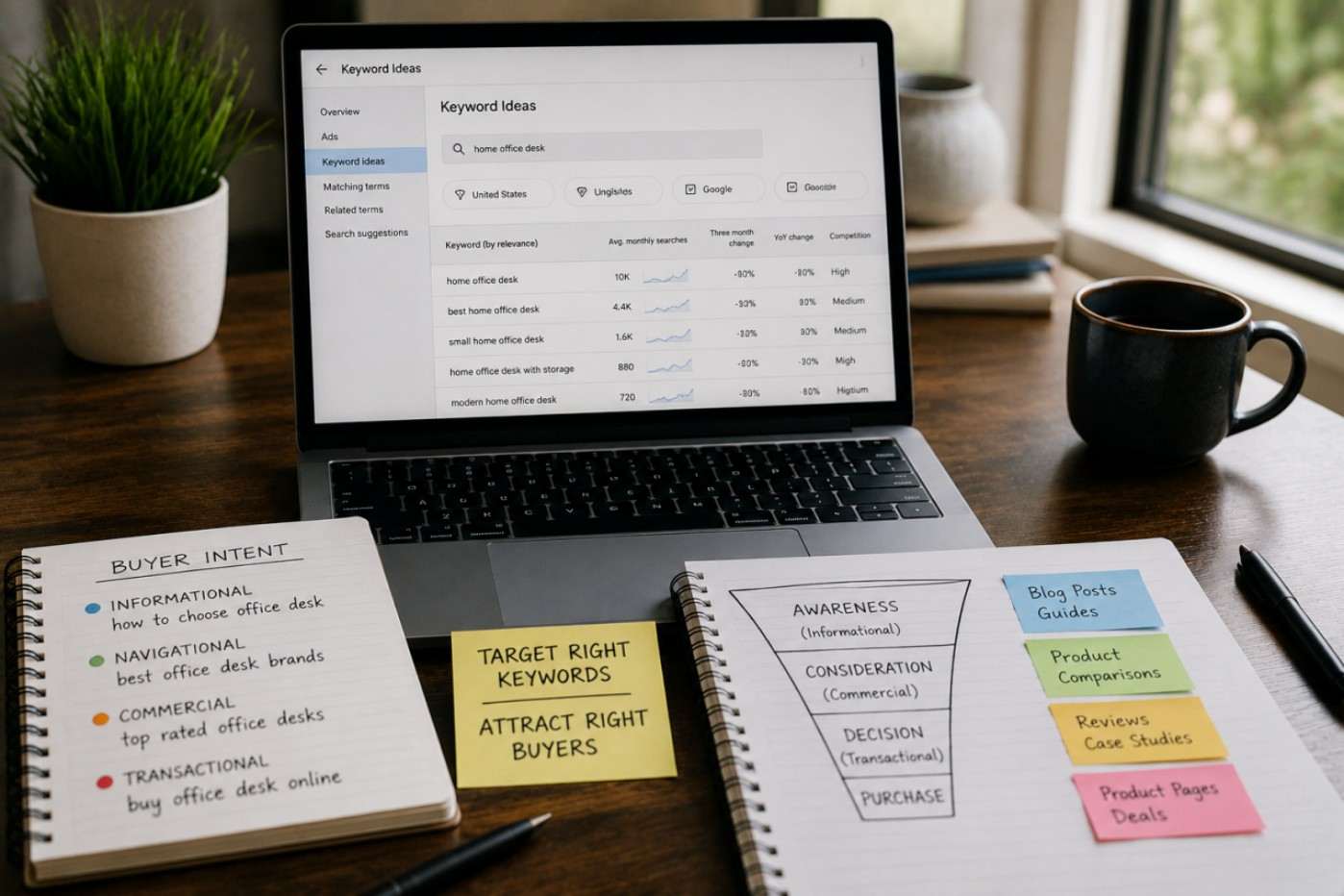
Every search sits somewhere on a spectrum. Understanding where a keyword sits helps decide what kind of page should target it, and what that page needs to say.
- Informational: The searcher wants an answer or an explanation, not a sale, such as “what does SEO mean.”
- Navigational: The searcher already knows the brand or site they want to reach, such as “Searchical SEO contact.”
- Commercial Investigation: The searcher is comparing options, such as “best SEO agency Dubai reviews.”
- Transactional: The searcher is ready to act, such as “hire SEO agency Dubai today.”
Academic research backs this up. A study from the British University in Dubai on consumer behavior in the UAE’s online market found that attitude and perception shape purchase intention far more than exposure to a brand alone, which is exactly why matching the right message to the right stage of intent matters so much. Separately, research published in the International Journal of Data and Network Science examined digital advertising channels in the UAE and found that mobile and targeted messaging carry a measurable effect on how consumers move toward a purchase decision.
Finding Keywords People Actually Buy On
There is no single tool that hands over a perfect list of buyer intent keywords. It takes a mix of data and judgement.
- Start with modifiers such as “buy,” “price,” “near me,” “best,” and “services,” since these usually signal a decision in progress.
- Mine the questions people actually ask, including Google’s People Also Ask boxes and autocomplete suggestions.
- Look at what competitors already rank for, then find the gaps they have missed.
- Check your own site search and sales team for the exact phrases customers use.
Seasonal timing matters too, particularly in the UAE. Search behavior shifts noticeably around Ramadan, White Friday, and back to school periods, when buyer intent spikes for entire categories within a matter of days. Reviewing last year’s search and sales data ahead of these periods is often more valuable than any keyword tool, because it shows exactly which terms turned into real orders rather than just clicks.
It also helps to separate keywords by device. Mobile searches tend to skew more transactional and more local, while desktop searches often lean toward research and comparison. Building content that respects this difference, rather than treating every visitor the same regardless of device, usually improves conversion without any extra spend on traffic.
Turning Intent Into Content That Converts
Finding the right keyword is only half the job. The page it points to needs to match what the searcher expects to find. A commercial investigation search deserves a comparison page, clear pricing signals, and social proof. A transactional search deserves a short path to a form, a call button, or a checkout, with as little friction as possible in between.
This matters even more for online retailers, where the gap between a browsing visitor and a paying customer can be a single page load. At Searchical SEO, ecommerce SEO service is built specifically around this idea, structuring product and category pages so they answer the exact question a buyer intent search is asking.
Small technical choices matter more than they get credit for. Clear pricing, visible reviews, fast loading pages, and structured data all reduce the hesitation a buyer feels in the last few seconds before converting. A page can rank perfectly and still lose the sale if it loads slowly or buries the price three scrolls down. Treat the page like a conversation with someone who has already decided to buy, and simply needs one more reason to trust you.
Local And Mobile Intent In The UAE
Search behavior in the UAE is shifting quickly toward mobile and, increasingly, toward AI assisted search. Research shared through Zawya found that a majority of UAE businesses are already adjusting their content for AI powered search, while coverage from Gulf Business reported that a large share of UAE consumers now feel comfortable letting an AI assistant complete part of the purchase for them. Trust plays a large role in this shift, and separate data published ranked the UAE among the most trusting markets in the world for digital transactions.
None of this replaces solid local SEO fundamentals. Google Maps, business profiles, and location pages still decide whether a nearby buyer finds you first.
The wider numbers support all of this. Economy Middle East recently reported the UAE’s ecommerce market climbing well past twelve billion dollars, and industry groups continue to push local businesses toward stronger digital foundations, which only raises the bar for search visibility across every sector.
What this means in practice is that buyer intent research can no longer stop at Google’s search box. Shoppers now ask AI assistants full questions, expect a direct answer, and often act on the first credible response they receive. Businesses that write content in a clear, question and answer format tend to appear in these AI generated answers more often than those writing in dense, keyword stuffed paragraphs, which is one more reason plain, natural language is worth protecting rather than sacrificing for rankings alone.
Mistakes That Quietly Waste Buyer Intent Traffic
- Sending high intent traffic to a generic homepage instead of a dedicated landing page.
- Writing content that answers the question but forgets to offer the next step.
- Ignoring Arabic and bilingual search terms that carry the same buying intent.
- Treating every keyword the same, regardless of where it sits in the funnel.
- Measuring rankings instead of measuring inquiries, calls, and completed sales.
The first mistake on that list deserves extra attention, because it is the most common one we see. A business ranks well for a strong buyer intent term, feels the win, and sends every visitor to the same homepage regardless of what they searched. The visitor lands, does not see their exact question answered, and leaves within seconds. All the work that went into ranking is wasted in that single moment, simply because the landing experience did not match the promise of the search result.
Bilingual coverage is worth calling out separately as well. A meaningful share of buyer intent searches across the UAE happen in Arabic, and businesses that only optimize their English pages are quietly handing that demand to competitors who bothered to translate properly, rather than relying on machine translation alone.
Keeping Score: What To Actually Measure
Rankings are a useful signal, but they are not the goal. Track enquiry form completions, phone calls, WhatsApp messages, and completed checkouts by landing page, then work backward to see which keywords actually produced them. Over time, this tells you far more than a spreadsheet of positions ever could, and it usually points to a handful of keyword themes worth doubling down on.
- Conversion rate by landing page, not just by the site as a whole.
- Cost per lead or per sale, tracked back to the specific keyword theme.
- Time from first visit to enquiry, which shows how much convincing a page still needs.
- Return visits before conversion, which often reveal a missing trust signal.
None of these numbers require expensive software. A well set up analytics account and a habit of asking every new customer how they found you will usually surface the same patterns that a large reporting dashboard would show. The goal is simply to keep asking which keywords produced revenue, not just which ones produced clicks.
Conclusion
Buyer intent keywords are not about chasing more traffic. They are about chasing the right traffic, the kind that is already leaning toward a decision. If you would like help finding those keywords and building pages that turn them into customers, get in touch with us and we will map out a plan built around how your customers actually search.
FAQs:
What is a buyer intent keyword?
It is a search phrase used by someone close to purchasing, often including words like buy, price, near me, or a specific brand name.
How is buyer intent different from search volume?
Search volume measures how many people search for a keyword, while buyer intent indicates how likely those searchers are to make a purchase. High-intent keywords typically generate better conversions, even if they have lower search volume.
Which keywords convert best for UAE businesses?
For UAE businesses, location-based keywords, comparison keywords, and pricing-related keywords generally convert well because shoppers often research local options before making a purchasing decision.
How long does it take to rank for buyer intent terms?
Most businesses see meaningful ranking improvements for buyer intent keywords within three to six months. However, highly competitive industries may require more time to achieve strong rankings.
Can small businesses compete for high intent keywords?
Yes. Small businesses can successfully compete by targeting local and long-tail buyer intent keywords, where larger competitors often have less focused or less relevant content.
Do buyer intent keywords work for local searches?
Yes. Buyer intent keywords are highly effective for local searches because users searching with local intent are often ready to make a purchase within a short period, frequently within a day or two.
